
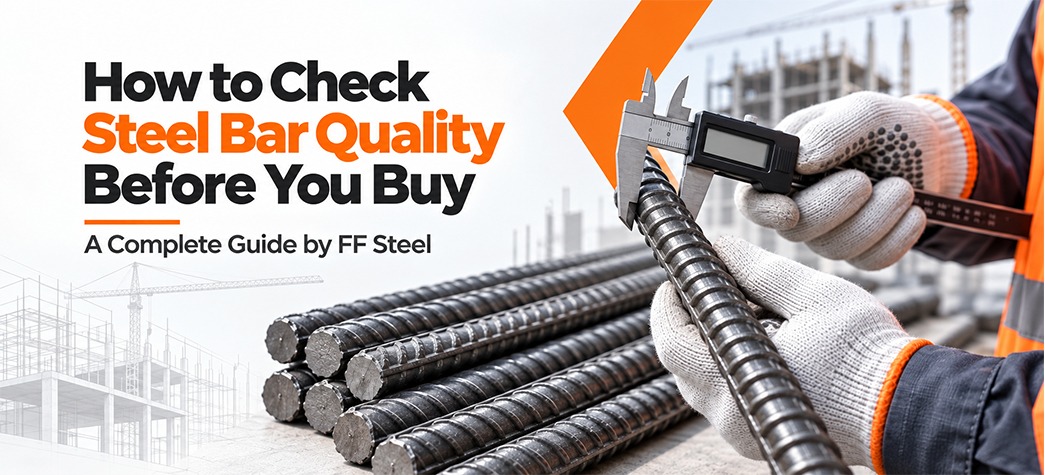
How to Check Steel Bar Quality Before You Buy
The steel bar you choose decides whether your structure stands strong for decades or develops cracks within a few years. The Pakistan Association of Large Steel Producers (PALSP) has told the government that around 40–50% of the steel bar sold in Pakistan does not meet PSQCA standards.[1] Here's how to check quality before you buy.
Why It Matters
Steel bars carry the tensile load concrete can't handle alone. Poor-quality bar means cracking, reduced load capacity, faster corrosion, and costly repairs, all invisible once it's inside concrete. That's why checks must happen before the bar is used, not after.
1. Check the Manufacturer
Pakistan's official standard, PSQCA PS-1879-2018, requires bars to be rolled from properly processed billets through controlled melting, refining, and rolling, not directly from re-rollable scrap or ship-breaking plates.[1] PALSP notes many mills violate this, which is a major cause of substandard steel in the market.[1]
Look for compliance with:
- PSQCA: PS-1879-2018
- British Standard: BS 4449
- American Standard: ASTM A615 / A706
Ask your dealer for the mill test certificate (MTC), confirm the grade stamped on the bar, and confirm it wasn't rolled from scrap.
FF Steel, established in 1986, is Pakistan's largest steel manufacturer with an annual production capacity of 400,000 tons across two plants in Lahore and Peshawar. It states it is the exclusive producer of Grade 60 and the sole producer of Grade 80 deformed steel bars in Pakistan, manufactured to ASTM A615, ASTM A706, and BS 4449.[2]
2. Do a Physical Inspection
Before any test, check the bar itself:
- Uniform thickness end to end — tapering signals poor rolling
- Clear, evenly spaced ribs — these create the bond with concrete; worn ribs weaken it
- Smooth surface — no cracks, pits, or flaking
- Straightness — twisted bars are harder to work with and often lower quality
3. Run the Bend and Rebend Test
This is the standard on-site ductility check referenced in reinforcement standards like ASTM A706.[3] A sample is bent to an angle around a mandrel, straightened, then bent again the other way.
- Good bar bends and rebends without cracking.
- Poor bar snaps or shows fissures at the bend.
Since bars are routinely bent on-site into stirrups and hooks, a bar that fails this test won't survive years of real structural stress.
4. Perform the Rust Test
Light surface rust is normal and usually clears during handling and curing. Deep rust, pitting, or scaling is a warning sign — it means the base steel has already started deteriorating. Scratch the surface: solid metal underneath is fine; flaking, pitted metal is not.
5. Ask About In-House Testing
According to its official facilities page, FF Steel runs two spectrometers (one per plant) to check chemical composition, and two Universal Testing Machines (UTM) per location to test tensile and ultimate strength — with a test conducted roughly every ten minutes of production.[2] When evaluating any manufacturer, ask whether they test their own output this consistently, and whether they can share an MTC for your specific batch.
Grade 60 vs Grade 80
Under ASTM A706, the grade number denotes minimum yield strength in thousands of PSI.[3] FF Steel, which introduced Grade 80 to Pakistan as the first local manufacturer of this grade, states that Grade 80 offers 33% higher strength, 13% less steel consumption, and up to 10% cost savings compared to Grade 60 for equivalent structural demands.[2]
|
Feature |
Grade 60 |
Grade 80 |
|
Min. yield strength |
60,000 PSI |
80,000 PSI |
|
Typical use |
Homes, plazas, general RCC |
High-rises, bridges, seismic-zone structures |
|
Steel consumption |
Standard |
~13% less for equivalent strength (FF Steel data)[2] |
|
Availability |
Widely available |
Limited producers, including FF Steel |
Grade 80 isn't automatically "better" — it's a specialized choice for high-load structures. Always confirm the required grade with your structural engineer.
Quick Checklist
? Certified brand with PSQCA/ASTM/BS compliance
? Manufacturer uses controlled raw material, not scrap
? Mill test certificate available for the batch
? Grade matches your engineer's spec
? Uniform thickness, clear ribs, smooth surface
? Passes bend and rebend test
? Only mild surface rust
? Correct weight per foot/meter
FAQs
How can I check steel bar quality without lab equipment?
Through physical inspection, a bend and rebend test, and a rust check — plus buying from a manufacturer that controls its own raw material.
Is rust on steel bar always bad?
No. Light surface rust is normal. Deep pitting or flaking scale means the steel has already deteriorated.
What's the real difference between Grade 60 and Grade 80?
Grade 60 has a minimum yield strength of 60,000 PSI; Grade 80 has 80,000 PSI. FF Steel states its Grade 80 delivers 33% higher strength and roughly 13% less steel consumption than Grade 60.[2]
Which grade should I use for a house?
Grade 60 is standard for homes and general construction. Grade 80 is for high-rises or where an engineer specifically calls for it.
Why does raw material sourcing matter?
PSQCA's PS-1879-2018 requires bars to be rolled from proper billets, not scrap. This is a major compliance gap PALSP has flagged across the industry.[1]
Is Grade 80 available for residential use in Pakistan?
Yes — FF Steel states it's the sole local producer, though it's mainly used in high-rise and infrastructure projects unless your engineer recommends it for a home.
Conclusion
Checking steel bar quality means combining a trustworthy manufacturer, physical inspection, a bend test, and a rust check, since problems become permanent once the bar is in concrete. FF Steel states it tests output via in-house spectrometers and UTMs roughly every ten minutes of production, across its Grade 60 and Grade 80 lines.[2]