
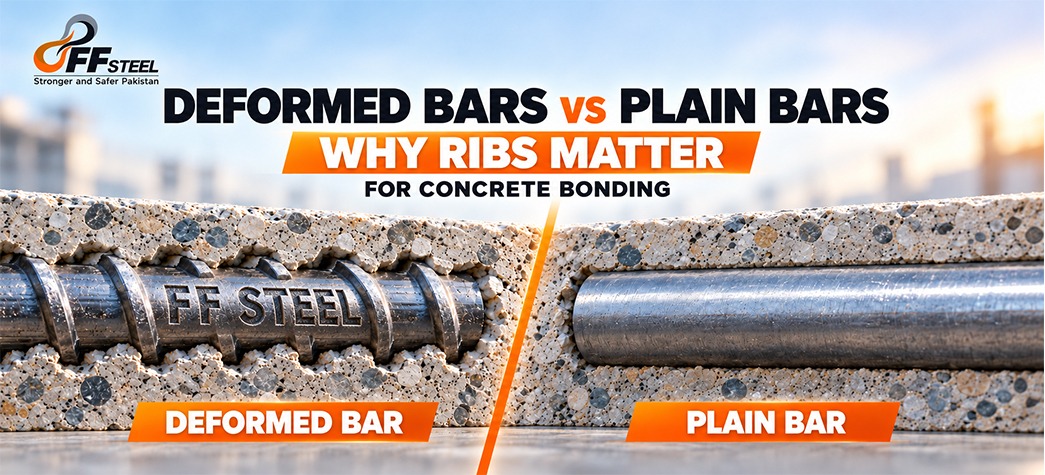
Deformed Bars vs Plain Bars: Why Ribs Matter for Concrete Bonding
Deformed bars carry raised ribs that lock into the surrounding concrete, whereas plain bars have a smooth surface and depend on adhesion and friction alone. This difference governs how effectively a bar transfers load to concrete, which is why structural concrete codes require ribbed reinforcement and restrict plain bars to spirals. The sections below set out how concrete bond works, what ASTM A615 requires of a rib, and what to verify when specifying steel bar.
How Concrete Bond Works
Reinforced concrete performs only if stress passes between steel and concrete. Bond is commonly understood as the combined result of three mechanisms: chemical adhesion, friction, and mechanical interlock between the ribs and the concrete. For ribbed bars, mechanical interlock provides the primary anchoring resistance.
ACI 318 bases its development length concept on the average bond stress attainable over a bar's embedded length, so anchorage and lap-splice lengths on a drawing are, in effect, bond calculations.
How Plain Bars Behave in Concrete
A plain bar has no lugs or other surface deformations and therefore cannot transfer bond forces by mechanical interlock. Bond is provided by adhesion until slip begins, and thereafter by friction and the wedging of small particles that break free from the concrete. In matched pull-out tests at Chang'an University, plain steel bars developed on average only 18.3% of the bond stress of deformed bars; an earlier study cited in the same paper reported 28.6%. In the ribbed specimens, adhesion accounted for roughly 2% to 5% of bond strength, with the authors identifying mechanical interlock as the dominant component.
How Ribs Create Mechanical Interlock
In a ribbed bar, load enters the concrete through the bearing of the ribs against the concrete between them. Because that bearing force is inclined to the bar axis, it also pushes the surrounding concrete outward. Two failure modes result: pull-out, in which the concrete between the ribs is sheared off, and splitting, in which cracks propagate radially through the concrete cover. Splitting is resisted by the cover surrounding the bar, so cover forms part of the bond design.
What ASTM A615 Requires of a Rib
ASTM A615 requires deformations to be spaced at substantially uniform distances and inclined at an included angle of not less than 45° to the bar axis, with an average spacing not exceeding seven-tenths of the nominal bar diameter. The gap between the ends of the deformations may not exceed 12.5% of the nominal perimeter, and the sum of the gaps may not exceed 25%. A minimum average rib height applies to each size. FF Steel publishes these limits in its ASTM A615 and A706 deformation requirement tables; representative values follow.
|
Bar No. [mm class] |
Maximum average spacing |
Minimum average height |
Maximum gap |
|
No. 4 [13] |
8.9 mm |
0.51 mm |
4.9 mm |
|
No. 6 [19] |
13.3 mm |
0.97 mm |
7.3 mm |
|
No. 8 [25] |
17.8 mm |
1.27 mm |
9.7 mm |
|
No. 10 [32] |
22.6 mm |
1.63 mm |
12.4 mm |
Source: ASTM A615, Table 1 (deformation requirements), as published by FF Steel.
Research at the University of Kansas, reviewing the work behind ASTM's deformation limits, found that bond strength is governed not by rib height or spacing alone but by their combination, expressed as relative rib area. ASTM A615 also requires dimensional tests, including rib spacing, height and gap, for each bar size rolled from each heat.
What the Codes Require
ACI CODE-318 requires that nonprestressed bars and wires be deformed, except that plain bars or wires are permitted for use in spirals. Its commentary confines plain bars to spirals used as column transverse reinforcement, shear and torsion reinforcement, or splice confinement. The Building Code of Pakistan (2021), published by the Pakistan Engineering Council and based on the 2021 International Building Code, builds its concrete provisions on ACI 318 and lists local modifications to it in Section 1905. Within that framework, ribbed bar is the baseline for primary reinforcement.
Ribs, Grade and Bond Demand
Grade states minimum yield strength; ribs govern bond. ASTM A615 provides for plain bars to be furnished in the same grades as deformed bars when ordered, so a plain bar may carry a Grade 60 designation without any bond benefit.
Bond demand also rises with grade. A higher-strength bar must deliver more force into the concrete before yielding, and ACI 318-19 reflects this: development length scales with yield strength and carries an additional grade factor of 1.0 for Grade 60 and 1.15 for Grade 80. Combining the two terms, a Grade 80 bar of the same size in the same concrete requires roughly 53% more development length than Grade 60 (80/60 × 1.15), before the engineer's detailed calculation. Specifiers weighing the savings FF Steel states for Grade 80 (33% higher strength, 13% less consumption, up to 10% cost saving against Grade 60) should review anchorage and splice detailing together with bar quantity.
FF Steel supplies both grades as ribbed deformed bar. It describes the ribbed pattern of its Grade 60 deformed steel bars as providing a strong grip between bar and concrete, and presents its Grade 80 rebar as the first produced in Pakistan.
Check Price of Grade 60 Today
To check price of Grade 60 today, or to compare it with the current Grade 80 rate, request the latest figures through FF Steel's online rate calculator. FF Steel states that it responds within 24 hours; the helpline, 111 888 999, is staffed daily from 09:00 AM to 6:00 PM.
Frequently Asked Questions
What is the difference between deformed bars and plain bars?
Deformed bars have raised ribs rolled onto the surface that create mechanical interlock with concrete. Plain bars are smooth and rely on adhesion and friction, which in pull-out tests produced only a fraction of the bond stress of deformed bars.
Why does rebar have ribs?
Ribs bear against the surrounding concrete and transfer load through mechanical interlock, the primary anchoring mechanism for ribbed bars.
Are deformed bars stronger than plain bars?
Not by definition. Strength is set by grade, which states minimum yield strength, and ASTM A615 provides for plain bars in the same grades. Ribs govern bond, not yield strength.
Can plain bars be used in reinforced concrete?
Under ACI 318, plain bars are permitted only for spirals — as transverse reinforcement for columns, for shear and torsion, or as confining reinforcement for splices. Primary reinforcement must be deformed.
Does Grade 80 change bond requirements?
Yes. ACI 318-19 applies a grade factor of 1.15 to development length for Grade 80, in addition to the effect of its higher yield strength, so anchorage and splice lengths must be detailed accordingly.
Conclusion
Deformed bars transfer load to concrete through mechanical interlock, and rib geometry is controlled by standard because concrete bond underpins every anchorage and splice on a structural drawing. Specifying ribbed bar to a recognised standard, at the grade the engineer has designed for, is the baseline for reliable reinforced concrete.